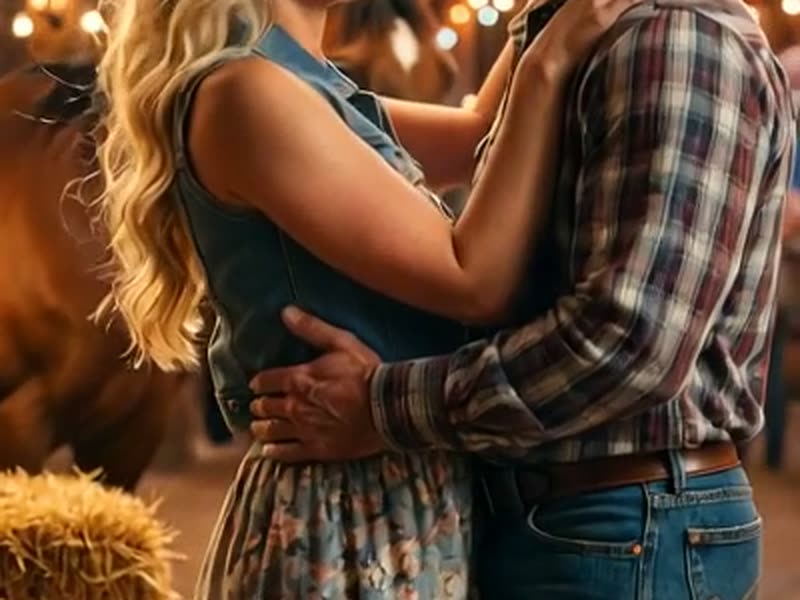
The harvest dance at the Hendersons’ barn is older than anyone still dancing at it. It has survived three renovations, two droughts, one fistfight over a pie auction in 1987, and every winter the valley has thrown at it. If you grew up around Cedar Falls, your parents met there, or made up there, or held you on their hip there while they swayed to the last song of the night.
Grace Whitaker had not been in two years.
The first autumn after Daniel died, nobody expected her. The second autumn, the invitations got gentle and persistent, the way small-town kindness does. Ellen Henderson drove out to the ranch personally with a casserole and left with a promise. “You don’t have to dance,” she said. “Just come stand in the warm.”
So on a golden Saturday in October, Grace put on the good boots she hadn’t worn since the funeral, told Lily to behave herself at her sleepover, and drove toward the music. And at the last moment, passing the bookshelf in the hall, her hand reached out on its own and took down Daniel’s journal, the battered brown one he’d kept for years, and tucked it into her coat.
She couldn’t have told you why. You bring a friend along when you’re scared.
The Hay Bale by the Door
The barn looked the way it always looks, like somebody had bottled every good autumn and poured it over the rafters. String lights swung between the beams. Someone’s grandmother was teaching someone’s grandson to two-step. The Hendersons’ old gelding leaned over his stall door at the far end, supervising the punch bowl, because at this dance even the horses attend.
Grace got hugged eleven times between the door and the refreshment table. Everyone was glad to see her, and everyone was careful, and the care was the hard part. Wherever she stood, the dancing bent around her like creek water around a stone.
So she found a hay bale at the edge of the light, half in shadow, and sat, and after a while she took out the journal.
She had been reading it slowly for two years, rationing it, a few pages a month, because when she reached the end there would be no more of him. She had rules about it, the private liturgies of grief. Never more than three pages at a sitting. Never at night, when the missing him ran deepest. Never the last section, whose pages she could feel waiting under her right thumb like a held breath, growing thinner every month no matter how she portioned them. Daniel wrote the way he talked, plain and warm with a joke tucked in the pocket of every paragraph. Feed prices. Weather. A colt that bucked him into the water trough. And every so often, without warning, a line that stopped her heart: watched G. hang laundry this morning and thought, eleven years married and I still show off for her.
The fiddle player leaned into something slow. Grace turned a page.
Orders Left in Advance
The shadow fell across the paper before she heard him. Caleb stood there with his hat in both hands, working the brim like he meant to reshape it, wearing the expression of a man who had rehearsed in his truck and lost every word on the walk over.
He’d been foreman at Willow Creek for six years. He had carried a casket on his shoulder and never once made Grace feel watched in her worst months, just quietly kept the ranch standing around her. If he was more than a friend in her mind lately, she had not permitted herself to look straight at the thought. Grief makes you superstitious about happiness.
“You don’t have to,” he said, all in a rush. “But the band’s about to play a slow one, and Daniel once told me if I ever saw you sitting out a waltz, I had orders to fix it.”
Grace stared at him. “He what?”
“Summer before he passed.” Caleb’s ears had gone red, but he held her eyes. “We were fixing the creek fence. He got quiet, the way he did, and then he said, ‘Caleb, my wife loves to dance and she’ll pretend she doesn’t. If anything ever happens to me, don’t you let her sit against the wall her whole life.’ I told him to quit talking foolish.” He swallowed. “But I said yes sir all the same. I’ve been carrying it around ever since, waiting on the nerve.”
The barn went a little blurry at the edges. Because here is what Caleb could not have known. An hour earlier, sitting in that same coat in her kitchen, Grace had read an entry dated ten Octobers back, after a harvest dance where she and Daniel had closed the floor down: If heaven’s real, I hope it’s this barn on the last song. And if I get there early, I hope somebody makes her keep dancing. She deserves a whole life of it, with or without me.
She had the page marked with her thumb while he was speaking.
The Waltz
She didn’t trust her voice, so she held up the journal, open, and let him read it. She watched the words land on him, watched this big quiet man blink hard and look up at the rafters and let out a breath like he’d set down a hay bale he’d been carrying for years.
“Well,” he managed. “Guess we’re both under orders.”
The band swung into an old waltz, the one every band in Montana knows, and Caleb held out his hand, and Grace Whitaker put down the journal on the hay bale, open to that page, and stood up.
The first eight bars were the hardest thing she had done since the funeral. Her body remembered dancing the way it remembered Daniel, completely, and the remembering hurt all the way down. But Caleb danced like he worked, steady and unhurried and paying attention, and somewhere in the second verse Grace realized her eyes were wet and she was smiling at the same time, and that both things were true and neither canceled the other.
That’s the secret nobody tells you about grief, and Grace will tell it to you now, straight out: the love doesn’t leave when you start living again. It comes with you. It always was going to come with you. Daniel was in that barn, in the lights and the fiddle and the ink drying ten years in a brown journal, and he was not watching jealously from some corner. He had arranged the whole evening. He’d been arranging it for a decade.
They danced twice more. Then Grace laughed at something Caleb said, really laughed, the kind that surprises the laugher, and half the barn pretended very hard not to be delighted about it. Ellen Henderson had to go stand by the punch bowl and compose herself. The fiddle player, who has been playing this valley’s weddings and funerals for forty years and misses nothing, caught Caleb’s eye on the next turn and gave him the smallest nod, one working man to another, a job long overdue and well begun.
The Last Song
Nothing is simple, and this story doesn’t end with a wedding. It ends smaller and truer than that. It ends with Caleb walking Grace to her truck under a sky full of October stars, both of them shy as teenagers, neither one rushing whatever this was going to be, because good things grown in slow country take slow time, and they both knew it.
“Same dance next year?” he asked.
“Ask me sooner than that,” Grace said, and got in the truck before he could see her face, and drove home with the radio off and her heart making a sound she barely recognized. Hope has a rhythm to it. It had been a while.
On the seat beside her, the journal rode home open to that October page. She reads it differently now. Not as a goodbye. As a man who loved his wife so thoroughly that he planted her healing in other people like seed, years ahead, trusting the harvest to come up after he was gone.
She deserves a whole life of it, he wrote. She’s starting to believe him.
If this story touched your heart, follow along for more of the Whitaker family’s journey at Willow Creek Ranch, stories about grief that softens, love that keeps its promises, and the music that calls us back to the floor.
