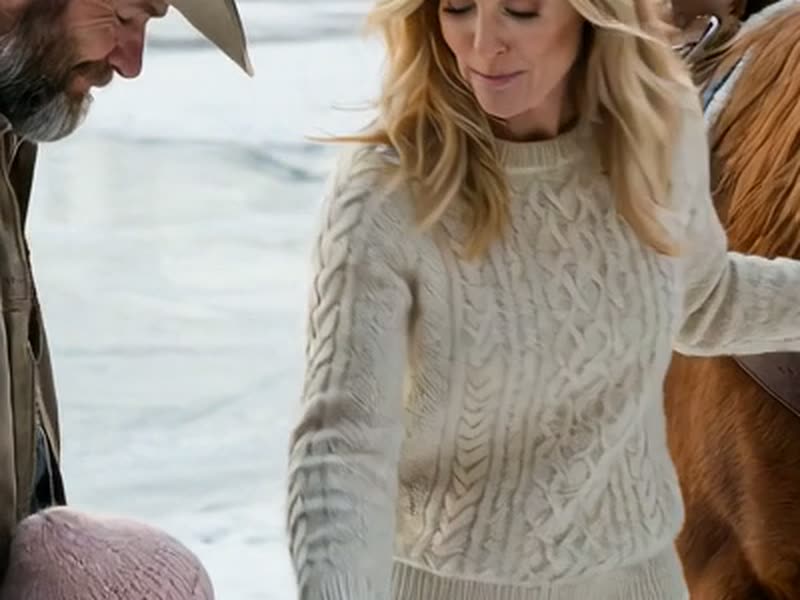
The first anyone knew of trouble was an open gate.
Maple was the gentlest animal on Willow Creek Ranch, a copper-colored mare with a blaze like spilled cream and the disposition of a favorite aunt. She was Lily’s first real horse, the one who had taught the girl to post a trot, the one who stood like a statue while a seven-year-old braided wildflowers into her mane. If you had asked anyone in the family which horse would never wander, every hand would have pointed at Maple.
But a latch can fail on the coldest night of January same as any other, and on a Tuesday morning Grace walked out to a gate standing open, tracks filling with fresh snow, and a corral with one horse too few.
Two Days of Nothing
They searched the way ranch families search, which is to say completely, methodically, and with their hearts in their throats the whole time. Caleb rode the fence lines north while Grace took the truck along the county road, crawling at ten miles an hour, glassing every draw and thicket. Samuel, who does not pray out loud, stood a long time at the barn door with his hat in his hand, and nobody asked him what he was doing.
Twenty below at night, that first night. A horse can survive cold, they’re built for it better than we are. But Maple was twenty-two years old, and the country west of the ranch runs down to Loon Lake, and lake country in January is a maze of ice and deadfall that has swallowed stronger animals than an old mare with kind eyes.
The second evening, Lily set Maple’s feed bucket outside the corral gate, where it could be seen from the road. “So she knows we’re not mad,” she explained. Grace turned away and pretended to check the latch, because there is a limit to what a mother’s face can hold.
The Shape in the Gray
The third morning broke gray and still, the kind of cold where the air itself seems careful. Grace and Samuel walked down toward the lake pasture at first light to check the shoreline, and Lily begged along, bundled in the pink coat until she was more coat than child.
It was Lily who saw it. Children look at the middle of a lake, adults look at the edges.
“There’s a man,” she said.
Far out on the frozen flat of Loon Lake, small and dark against all that white, a figure was walking. Not skating, not hurrying. Walking, with the deliberate patience of someone who respects what’s under his boots. Samuel raised a hand against the glare and went very still, and Grace felt the morning tip in that direction the whole world does when something is about to matter.
“He’s got a horse,” Samuel said quietly.
And he did. Stepping along beside the man on a lead rope, unhurried, lifting her feet neat and placing them like a lady choosing her way across a wet lawn, came Maple. Even at that distance Grace knew the blaze, knew the way the mare carried her head, and her knees went loose with a relief so sharp it felt like grief’s twin sister.
Lily was already running. Grace hollered at her to stay off the ice and the stranger raised one hand, calm and easy, a gesture that said all at once: she’s fine, I’ve got her, and don’t come out here, the ice won’t hold three.
The Man Who Wouldn’t Take Money
Up close he was younger than his walk, maybe thirty, with a beard rimed white from his own breath and the weathered gear of a man who spends winters outdoors on purpose. He handed the lead rope to Samuel with a nod, and Maple pushed her nose into Lily’s hood and blew warm air down the girl’s neck, and for a minute nobody could talk over the reunion.
His name was Dane. He was wintering in a cabin on the far shore, a wildlife survey job, counting eagles for the state. Maple had turned up at his woodpile the evening before, hungry and dragging a broken length of lead she’d snagged somewhere, and he’d read the brand, looked at the map, and figured the shortest safe way home was straight across, where he knew the ice because he’d been drilling test holes in it all winter.
“Four miles around by the road,” he said, “or one and a half across. She was tired. We took it slow and I stayed on the thick line.” He said it the way other men describe checking the mail.
Grace tried to pay him. She had folded bills in her coat pocket before they’d even reached the shore, because that is how you thank a man in this country, you make it real. Dane looked at the money and shook his head once, polite as a fence post and about as movable.
“Tell you what,” he said, and looked out at the gray morning, and Grace would remember later that he seemed embarrassed by his own request. “I’ve been eating my own cooking since October. If there’s ever a chair at your table some Sunday, I’d call that square.”
Samuel went quiet for the rest of the day. Grace caught him twice standing at the kitchen window, looking down toward the lake, and she knew what was working on him. It wasn’t the mare, though the mare mattered. It was that a man alone in the cold country had been asked to name any price, and what he was hungry for was a family’s noise around him.
Sunday
He came the next Sunday, scrubbed and terrified, carrying a jar of wild honey as a hostess gift because his mother had raised him right before the world sent him off to count eagles alone. He stood on the porch a full minute before he knocked. Grace saw him through the window, checking his boots, squaring his shoulders like a man about to give testimony, and she understood all over again what months of solitude do to a person’s courage. Company gets to be a language you’re afraid you’ve forgotten.
He hadn’t. Or the table taught it back to him fast. Lily interrogated him about the ice until he drew diagrams on a napkin, test holes and thickness lines and the dark seams where springs come up and the ice lies about itself. “You can hear it talking,” he told her, dead serious. “It groans before it gives. The trick is you have to be listening before you’re in trouble, not after.” Samuel, who had been quietly grading this young man all afternoon the way old ranchers grade weather and fence posts and character, looked up from his plate at that and gave a single slow nod, which anyone at that table could tell you is Samuel’s highest academic honor.
He ate three helpings of pot roast and turned red when Grace noticed, and she made him a plate to carry home without asking, wrapped in foil, the way you do for family.
He still comes, most Sundays. The eagle survey ended in March and the state offered him another county, and he turned it down, took work instead at the feed store in Cedar Falls, and nobody at this table pretends anymore that it was about the job.
Maple, for her part, has never once looked toward the lake since. Whatever adventure was in her, one cold walk cured it. She stands at the corral gate on Sunday afternoons and watches Dane’s truck come up the drive, and greets him with a low nicker, the two of them keeping a secret about four dark miles that the rest of us will never fully know.
Here is what Grace says about that January, when she tells it. She says they lost a horse for two days and gained a chair at the table for good, and that the country they live in is hard, but it keeps making people like that, quiet men who walk lost things home across the ice and ask for nothing but company.
Kindness is still out there, friends. Sometimes it’s just far out on the gray, walking slow, on its way to you.
If this story warmed you, follow along for more from Willow Creek Ranch, where the winters are long, the table is loud, and there is always room for one more plate.
