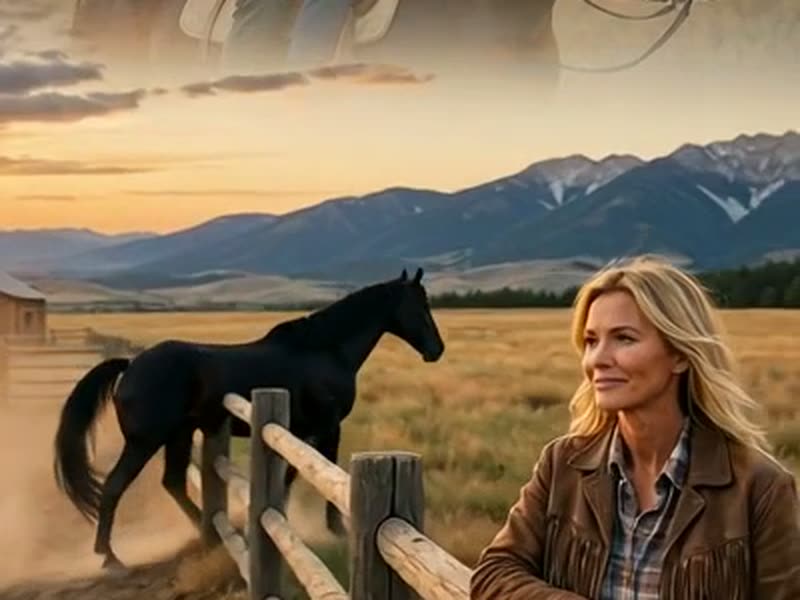
The stallion came to Willow Creek Ranch on a Tuesday in December, on the last trailer of a bankruptcy auction, wearing a halter he’d half destroyed and a reputation that had knocked a hundred dollars off his price every time he changed hands.
He was beautiful the way storms are beautiful, coal black head to hoof, not one white hair on him, with a mane that had never been pulled and a way of standing in a pen like he was doing the pen a favor. Six years old. Three brands’ worth of history. The auctioneer, a man not famous for honesty, had a moment of it when the bidding stalled: “Folks, I’ll say it plain. He’s not mean. He just never agreed to any of it.”
Grace Whitaker raised her hand and could not entirely have told you why.
Five Months of No
They called him Ink, because Lily said he looked like midnight spilled out of a bottle, and the name stuck the way children’s names for things do.
He was not cruel, the auctioneer had that right. He never once tried to hurt anybody. He just declined. He declined the halter, the lead, the farrier, the routine. He took hay from the feeder only after whoever brought it had gone. He kept one eye on every human in his field of view with the vigilance of an animal that had learned somewhere, from somebody, that agreeing is how they get you.
Caleb, who is good with hard horses, got nowhere in a month and said so without shame. “That’s not a training problem,” he told Grace over the fence. “That’s a trust problem. Different tool box. Longer clock.”
They pieced his history together from brand records and sale-barn gossip, the way you reconstruct any refugee’s road. Started under saddle too young by an outfit in a hurry. Sold on when he objected. Sold again when the objections organized themselves into philosophy. Each new owner had inherited the last one’s shortcuts and added their own, and somewhere along that road the horse had drawn the only conclusion the evidence supported: men are weather. You don’t trust weather. You endure it.
“Nobody ever hurt him big,” Caleb said. “I’d almost rather. Big hurts, they can heal clean. This one got chipped at. Chipped horses take longest, because they’re not wrong about anything. Everything he believes really happened to him.”
So Grace took the long clock. Every morning after chores, twenty minutes in the corral, asking nothing. She read seed catalogs out loud sitting on the mounting block. She learned his tells, the ear flick, the weight shift, the particular quality of stillness that meant today, stay wide. Winter into spring, five months of showing up, and by May she had earned exactly this much: he would eat with her present, at the far rail, facing her.
Everyone measures progress differently. Most of the valley measured it as none.
The Argument at the Kitchen Table
It was Samuel who finally said the hard thing, because saying the hard thing is what Samuel is for.
“You’ve given him half a year and he’s told you his answer,” he said one night. “Some animals carry too much history. You can’t love it out of them. You’re pouring your mornings down a well.”
“Then what would you do?” Grace asked, tired.
“Sell him to the rough stock contractor. He’d make a fine bucking horse. No shame in it, that’s the work he keeps applying for.”
Grace didn’t answer. But she lay awake that night with the window open, listening to a horse pace a fence line in the dark, back and forth, back and forth, the sound of an argument nobody was winning. And somewhere before sunrise she understood something about the animal down there, and maybe not only about the animal: you cannot prove to a heart that it’s free by holding it somewhere nice. Freedom isn’t a quality of the fence. It’s the gate.
She came down to breakfast and announced her plan, and the table went quiet, and Samuel said one word: “Foolish.” But he put on his coat and came to watch, which with Samuel is a whole speech about love.
The Open Gate
Gray morning, mist still sitting in the low field. Grace walked down to the corral where Ink stood watching, always watching, and she did the thing five months of patience had earned her the right to do honestly.
She unlatched the gate and swung it all the way open. Wide open, pinned back against the fence, no tricks. Beyond it lay the lane, and beyond the lane the open pasture, and beyond that the hills where a black horse could disappear into the timber and cost a family every dollar and every morning they’d spent on him.
Then she walked to the middle of the corral, sat down on the mounting block, and stopped asking for anything at all.
Ink went still in a way none of them had seen. He looked at the gate. He looked at her. He walked the fence line once, fast, mane snapping, and pulled up hard at the opening with the mist rolling past his knees, one hoof already in the lane, nostrils wide, reading the wind off those hills like a letter from home.
Nobody on that fence breathed. Lily had both hands over her mouth. Caleb told it afterward that his own heart was going like a colt’s, and Samuel stood with his arms crossed and his jaw set, a man watching money and something more than money stand in a doorway between two lives.
The stallion stood in that open gate for a long minute. Sixty full seconds, Caleb swears, though nobody was fit to count.
Then he turned. And he walked, unhurried, deliberate, the way he did everything, back across the corral to where Grace sat, and he did what he had never once done in five months. He dropped his black head down to her level and rested it there, forehead to her shoulder, breathing.
The gate stood open the rest of the day. He never looked at it again.
What He Was Waiting For
Ink is still at Willow Creek. He’s out at grass with Blue and Maple most days, and he comes when Grace calls, mostly, on his own schedule, because agreeing and surrendering are different words in his dictionary and this family has learned to respect the difference. The farrier can shoe him now. Lily is not allowed on him yet, and knows better than to campaign.
The gate ceremony, as the family calls it, repeats itself in smaller ways all the time now. Grace leaves his stall open while she mucks it. Leaves the corral unlatched during grooming. Every open latch is the same question asked again, and every time he stays, the staying belongs to him a little more. Samuel watched this routine for a month before he passed judgment, and when it came, it was pure Samuel: “Most expensive door prize in Montana,” he said, and then, going out, with his back turned so nobody could make anything of it, “Your mother-in-law gentled me about the same way.”
But here’s the line people repeat, the one Grace said that night at supper when Samuel, chewing, muttered that he’d never seen the like. She said: “He was never asking to leave. He was asking whether he could. There’s no way to answer that with a closed gate.”
Some hearts are like that, friends. Horses and people both. They can’t hear “you’re safe here” through a locked door, no matter how kind the voice. They need the terrible, generous proof, the open gate and someone sitting quietly inside it, willing to lose them, hoping to be chosen.
Choose people that way, if you can bear it. It’s the only choosing that counts.
If this story moved you, follow along for more of the Whitaker family’s journey at Willow Creek Ranch, stories about patience, trust, and the wild hearts that stay only because they’re free to go.
